

Now that I’ve been able to have the time to work on bigger projects and dig deeper analytically, I do have new ideas and concepts to share. Over the past month I’ve really gotten into the idea of building ranges of outcomes for every hitter and pitcher, then putting together histograms for players that I’ve come up with on my own. I can share from my projections that I have made adjustments up and down for players where I’ve seen it necessary, in order to create more believable and accurate outcomes. For the most part, I try as much as possible not to mess with projections for players where I feel their projection is already really good and spot on. The players I adjusted for here are Guerrero, who I felt needed a projection boost considering points leagues are his clear strong suit. He’s earned a projection over 500 points with his consistent production throughout his career. I lowered the projection for Kurtz because I felt it was appropriate, but you’ll see he still has the second highest projection.
The only other one I changed was for Ben Rice, who really needed a boost because of the fact he’s going to play every day at first base for the Yankees in 2026. For Rice, it makes sense to use him at catcher since he will be eligible there, but I still wanted to show where I’d rank him at first base. If you think about a projection, it’s essentially the average of all likely outcomes for a player, but I was more interested in ranges of outcomes because I see that as much more realistic and useful than an exact number. I also like there to be actual outliers to get an idea of what the floor and ceiling may look like. At the end of each player breakdown, you will see the histograms I’ve put together for each one, with what I see as the range of outcomes for each hitter.
1. Vladimir Guerrero Jr. (513.75) – To clarify, the points next to each player’s name are the point projections I have for each player for 2026. As you can see, the rankings do not just go in order of projections, or I would just release rankings entirely based on projections. It’s not the way I evaluate, as I feel it’s too simple and easy to just rely on projections. Someone like Guerrero also gets value from the fact his projection is just what his floor is. This is an easy one for me to rank first, because you aren’t going to find a better or safer option in a points league. In order to spend a top two round pick on a first baseman in a points league, he has to be safe while consistently producing elite production, and Vlad does exactly that. People often complain about his lack of home runs, but his approach is exactly what makes him great. He hits the ball hard all over the field and isn’t up there just trying to hit home runs. That type of production is actually much more bankable than someone who has to hit a bunch of home runs to be useful. I think he often gets talked about negatively or like he underperforms because he doesn’t hit 30 home runs most seasons. The reality is that it’s overblown, and if there was any question who the best first baseman now is, he more than proved it in the postseason. I do still prefer his skillset and profile over the players like Kurtz and Alonso who do hit more home runs. A stat I’ve started looking at in my evaluations for points leagues is runs + RBI + BB, and Guerrero produces one of those outcomes in 38% of his plate appearances.
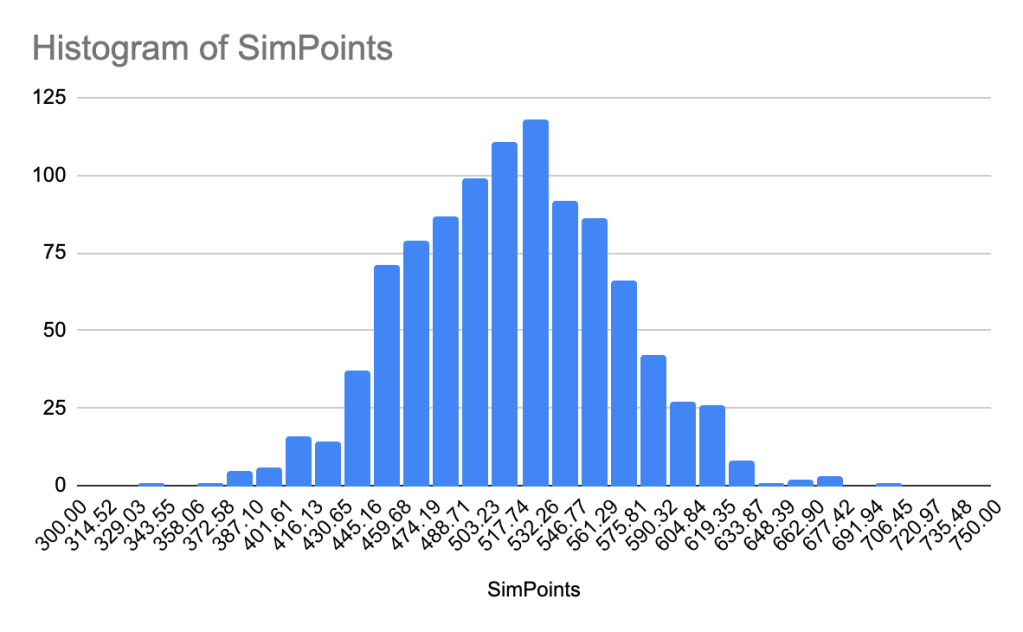
Vladimir Guerrero Jr. range of outcomes: 470 to 570 points
2. Pete Alonso (466.02) – You’ll notice that Vlad and Alonso are both two of six players on this list that have projections very close to each other. For a power hitter, Alonso has the profile among first basemen that you can count on the most. He’s a safe bet to hit 35 or more home runs with the potential to hit 50 when he plays a full season. His bankable power production and ability to hit the ball hard and drive it is why I rank him second here. He’s had a long track record at the position, and as long as he’s back with the Mets or in the middle of a good offense I expect a repeat of his last season. Like Guerrero, Alonso produces a run, RBI, or BB in 38% of his plate appearances.
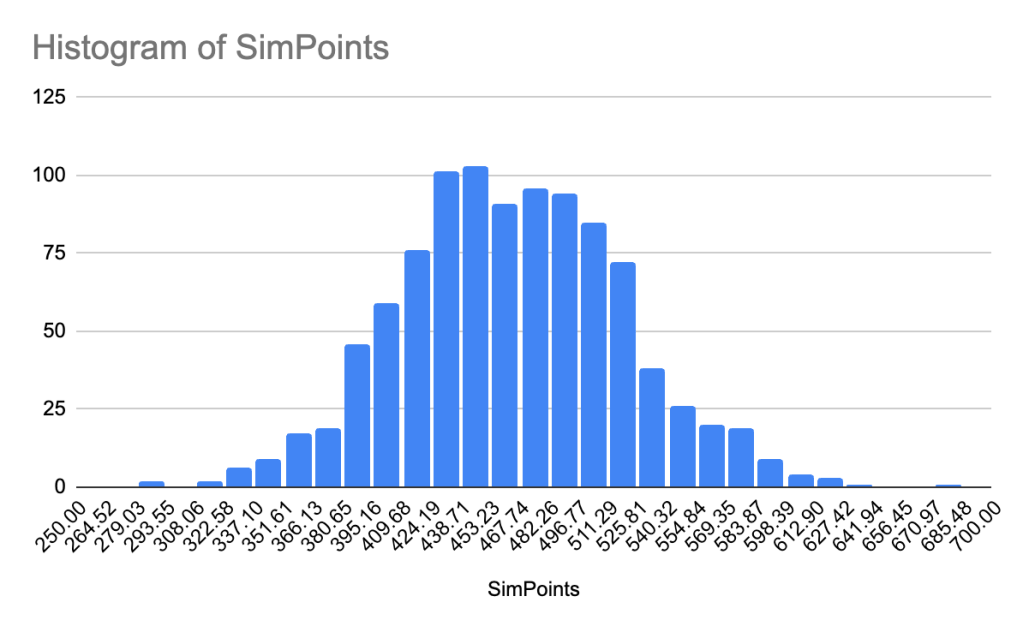
Pete Alonso range of outcomes: 415 to 540 points
3. Rafael Devers (453.72) – I never would have originally thought I’d be this high on Devers in my first base rankings, but in studying him I’ve come away more impressed than I anticipated. I don’t love him as a real life player, but for fantasy purposes that really doesn’t matter. The numbers tell me he’s incredibly valuable in a points league. He was one of only 5 MLB hitters to have 200 runs + RBI and 100+ walks in 2025, with the other 4 names on that list being Aaron Judge, Juan Soto, Kyle Schwarber, and Cal Raleigh. That’s quite the group to be a part of, and he only trails Nick Kurtz among all first baseman in producing one of those results in 44% of his plate appearances. Part of me is tempted to rank Devers second. He’s a player where diving into his profile and analytics have actually made me like Devers a lot more than I ever expected to in points leagues. What stands out is the amount of walks he now draws with a patient approach, racking up 112 walks in 2025.
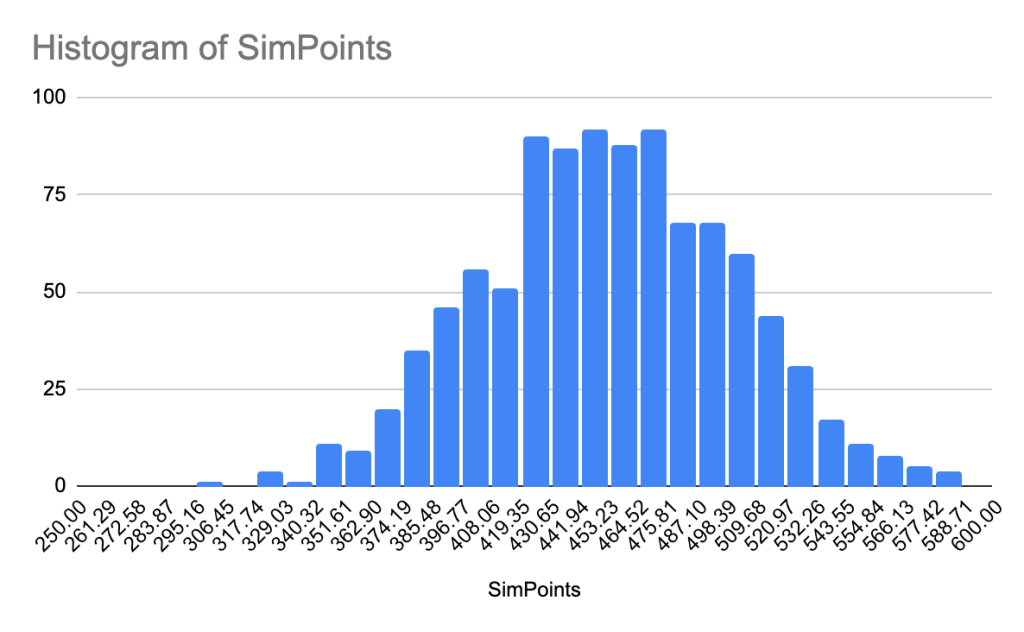
Rafael Devers range of outcomes: 420 to 520
4. Nick Kurtz (479.26) – You will notice that my projections very clearly like Kurtz the most here, but the lack of track record for Kurtz led me to rank him 4th here. I believe in order to take a player in the 2nd or 3rd round (likely where Kurtz is taken) it needs to be a safe pick and one that has a track record where you know it will produce tremendous value. That could happen with Kurtz, and while I actually am as high on Kurtz as anyone I’d be most comfortable taking him in the 4th round. He clearly has the upside to make this ranking look silly and could hit 50 home runs, but I’m going to make him prove it first. I would likely rank him first in a dynasty context, but I had to give a conservative ranking since I trust the 3 names ahead of him more. You’ll notice with Kurtz that he has a much wider range of outcomes, which makes sense when you consider his volatility, and the fact he can be very boom or bust.
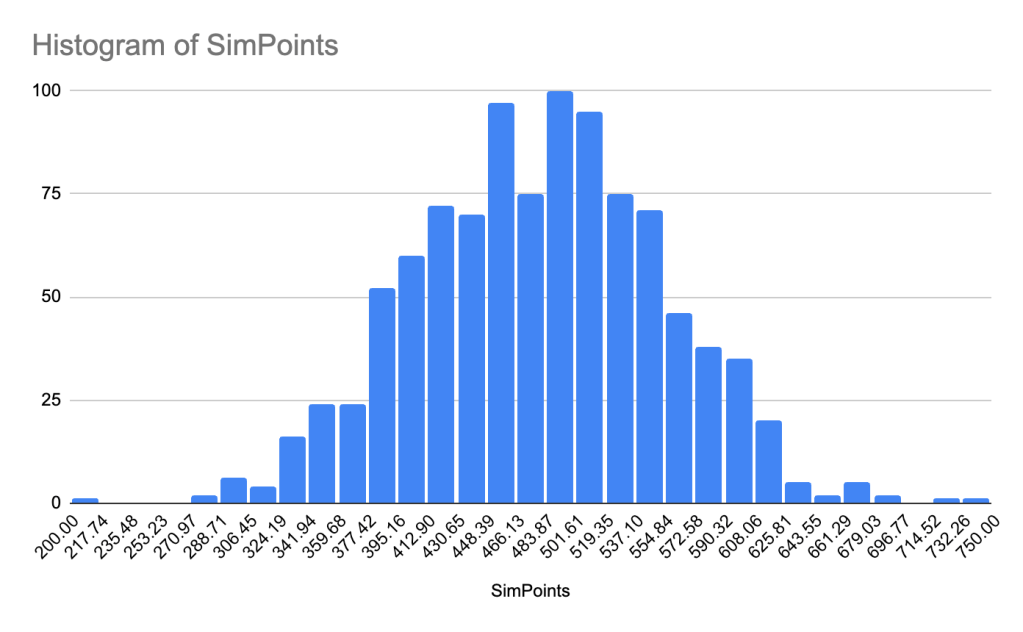
Nick Kurtz range of outcomes: 400 to 560 points
5. Matt Olson (446.7) – The safety and high floor of Olson tempted me to rank him ahead of Kurtz, especially when he’s shown his own high ceiling and ability to hit 50 home runs. I think we have enough proof to see he’s more like a 30 home run hitter, but it’s hard to pass up his consistency. He also is the best bet to stay healthy and play all season, as he hasn’t missed a game in years. All of those things are reasons I love him in a points league, where he’s just a volume play who is dependable.

Matt Olson range of outcomes: 400 to 500 points
6. Bryce Harper (455.41) – Maybe Harper is being unfairly punished and slept on going into the 2026 season. I do think there’s a chance that’s true, but the reality is he rarely stays healthy for a season and has a track record of only playing in 120-130 games while also playing through injury. I also believe, though, that Harper still possesses massive upside and still hits in the heart of a strong Phillies offense. All the underlying metrics for Harper are still really strong, and from a plate appearance perspective he’s still very productive. His 0.739 points per plate appearance is better than both Matt Olson and Rafael Devers, so if he could produce their volume he would actually outscore them. Those are two players who also didn’t miss a game all season, so you can hardly expect Harper to match that even as a best-case outcome. For all those reasons I think 6th is a proper ranking, even though he could be higher or lower than this ranking based on how you want to look at his profile.
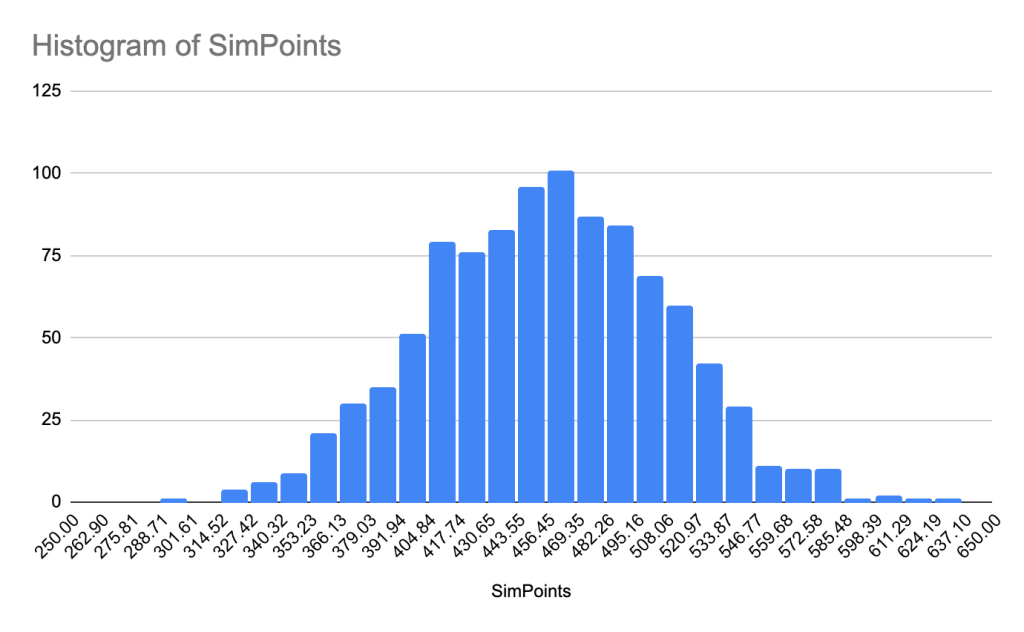
Bryce Harper range of outcomes: 400 to 520 points
7. Freddie Freeman (421.39) – Freeman is as consistent and steady as they come, but his age is finally starting to catch up to him unfortunately. He has the profile to age slowly, and will continue to have a high floor even in 2026. When he plays, he’s still very productive in points leagues, and his high floor makes me keep my trust in him even as he ages. I think you know what you are getting with Freeman at this point, where you can bank on 420+ points hitting in a great lineup and won’t be disappointed as long as you’re not expecting his elite production to return to where he scored over 600 points. My reasoning for ranking Harper just ahead of Freeman is that he’s younger and still has the capability of having an elite season.
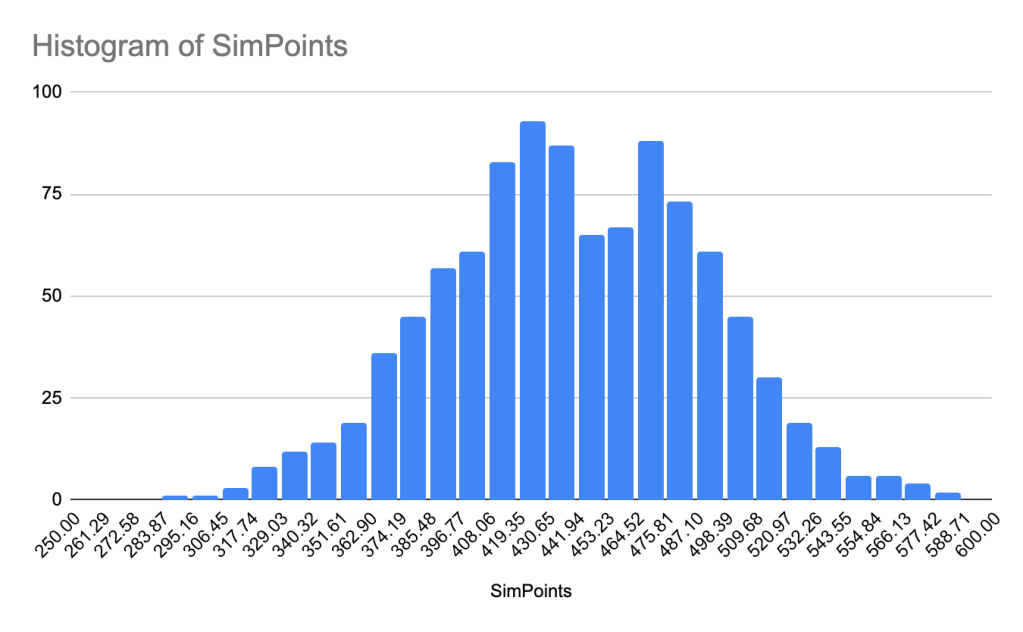
Freddie Freeman range of outcomes: 400 to 500 points
8. Josh Naylor (446.36) – Naylor is probably a player I judge too harshly for not having good plate discipline, but I just think it leaves the possibility for much more variance in his profile. I do think his track record helps me not worry about it too much, but I still can’t just completely ignore it. If I could draft Naylor as the 8th first baseman I would be thrilled with that value, and it will be interesting to see where he ends up in free agency, because he could go somewhere that potentially boosts his value and production. There is still a ton I like about Naylor, as he always feels like a max effort player who also hits the ball incredibly hard, but that sort of effort also tends to take its toll on Naylor, but even when he’s banged up he usually finds a way to be productive and stay in the lineup anyway. His projection would tell you there isn’t actually much of a gap between Vlad and Naylor, and that waiting to take Naylor in drafts is actually the better idea and use of your resources.
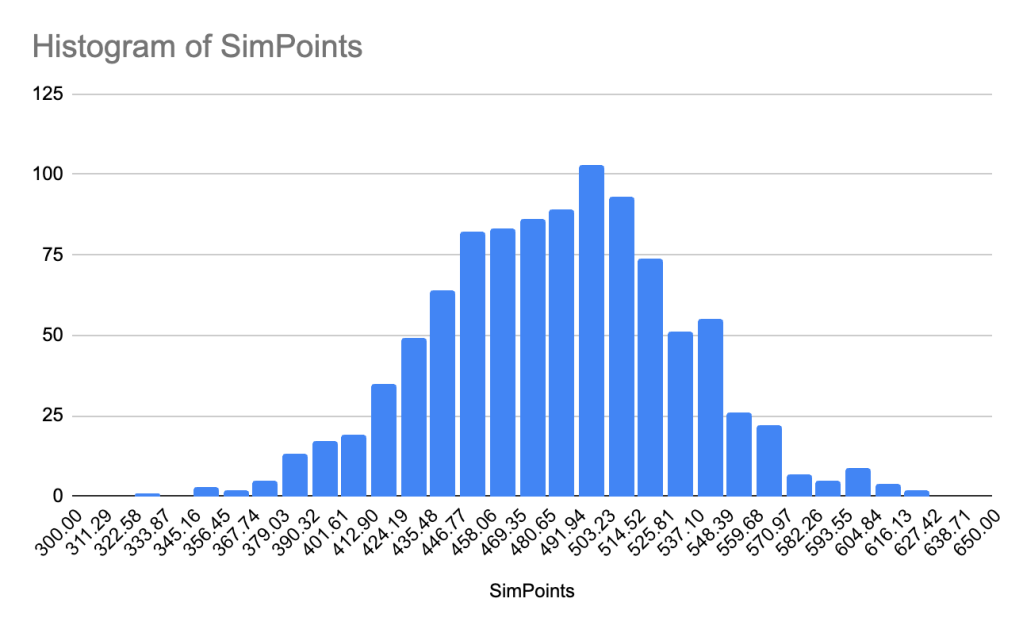
Josh Naylor range of outcomes: 430 to 530
9. Ben Rice (435.67) – To me, Rice is a much more exciting option to use at catcher for fantasy baseball purposes, but he’s so good that he’s still deserving to be ranked in the top 10 at first base, even if most people will not use him there in points leagues. I am to the point of leaning toward keeping Ben Rice since it’s been announced he will be the every day first baseman for the Yankees in 2026. I think the very best outcome for Rice would be an elite season where he hits close to 40 home runs, and with the playing time I truly believe he has that upside. I think the last two months of the 2024 season prove that, when he had an OPS of 0.918 over those two months while playing every day. His statcast metrics would tell you there is even more potential here, considering he had a 97th percentile 0.395 xwOBA.
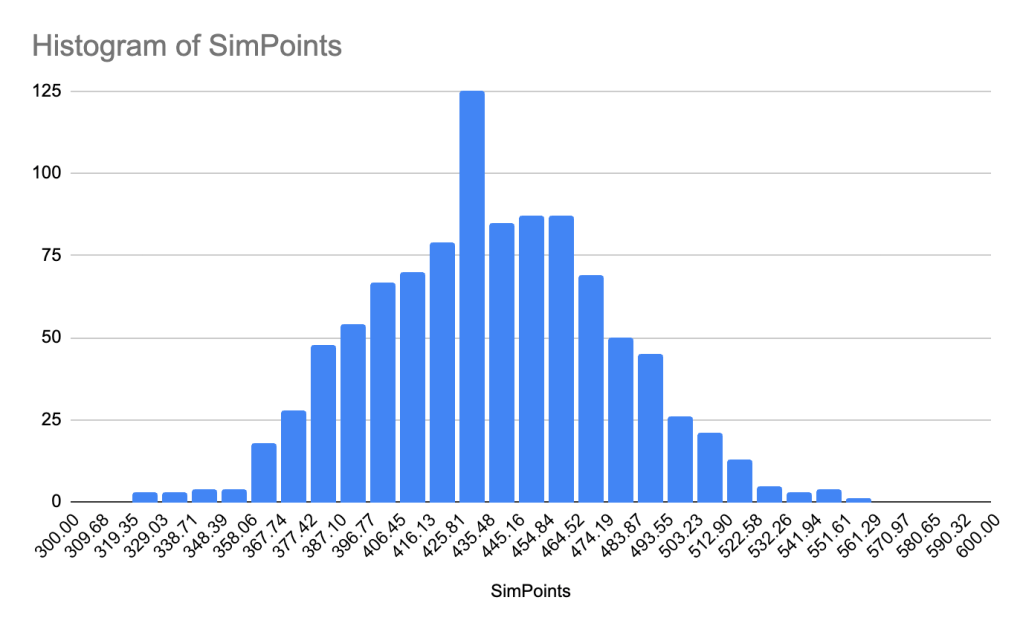
Ben Rice range of outcomes: 400 to 500
10. Vinnie Pasquantino (402.32) – The pasquatch was a player I was actually pretty low on entering the 2025 season, where I no longer understood the hype around him. I was starting to see him as a bust, and the first two months of the 2025 season didn’t do much to change my stance. From there, he went on to produce elite production the rest of the year, ending up with 32 home runs and 113 RBI and proving me wrong in the process. I was starting to doubt he would return the potential we were once promised, and I’m sure glad he proved me wrong as well. There was even a league where I took the discount in draft season, so I was still able to reap the rewards of his breakout season anyway. I also had concerns about his ability to hit for power at Kauffman stadium, so it was also great to see him reach 32 home runs. I’m not sure anyone thought he had that kind of power upside. He is also a pretty safe option I would say, and it doesn’t hurt that he’s in a division with some pretty bad teams. If the playing time was guaranteed, I would rank Michael Busch ahead of Pasquantino, but the platoon potential still makes me nervous. Until I see the Cubs for sure move away from that, I can’t put someone in the top 10 who isn’t guaranteed to play every day.
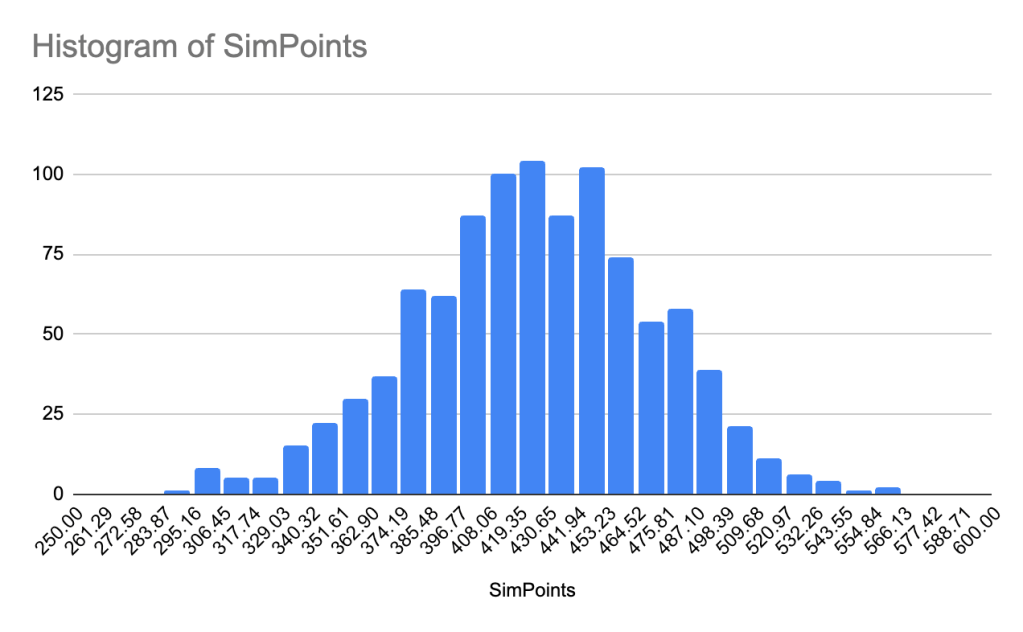
Vinnie Pasquantino range of outcomes: 380 to 480 points
To review, in my experience practicing mock drafts, I’m finding that I’d like to wait and not be the first one to draft a first baseman, mainly because I don’t see that much separation going from 1-8 in the rankings. When I would be happy and content with any of them, I see the best strategy as waiting and trying to get the last one. The only thing I would say is not to wait too long, because all the top ones will be taken rather quickly. I think all of them may go in the first four rounds, so I want to make sure I get one of them. I probably won’t risk missing out, so I’m hoping to target one of them in the 3rd or 4th round. I think Devers is being slept on and will offer tremendous value if he can be taken in the 3rd round.
In other news, I’m still trying to figure out what my long-term goal is with all this and what I really want to do. I enjoy writing about baseball and building that habit throughout the 2025 MLB season and beyond has been great for me. I feel the most passionate and fulfilled when I’m really studying data and building formulas and simulations on spreadsheets. For me, it feels like easy and simple work at times, even though I know it wouldn’t be for the average person, or someone not obsessed with data daily. On the formula and data side of things, it all essentially started out for me as wanting to find an edge over the competition and to fulfill that competitive side for me. I’ve spent the last few weeks thinking about things and what I’m really after and my reasoning for doing all this, and it’s again circled back to that part of me that wants to find an edge in fantasy baseball over the rest of the competition. That still very much exists, and while I do want to share my knowledge and try to help others, I’m struggling to know exactly how to do that. I’ve worked hard to find the data I have, and it would be unfair to myself to just release that information freely to everyone. I see it as being tremendously valuable and worth protecting, but am still clearly working through how exactly to get useful information out there without totally giving away all my secrets.
As far as using my expertise in data analytics with my degree to apply that to fantasy baseball, it’s making me wonder how somebody else didn’t think of this. I do believe in my heart I have innate ability in this area and think in a way that can’t just be easily duplicated, and as arrogant as that may sound I truly mean it in a genuine way. I think it’s the reality, but I do want to use my skills for more than just myself here. If you tried to organize all of my work I’ve done around a central idea, I think it would be that I want to study this and master it to the point where I could teach a course on my entire strategy and processes I’ve deployed. I started out wanting an outline of my entire process and strategy, but in the process of doing this I found that my entire strategy needed to be changed or honed in a much more intentional way. So while my strategy is constantly evolving and changing, I’m wanting to go back to the outline idea and incorporate it into where I’m at now. I believe my abilities are put to its best use if I master the things I can control in fantasy baseball to where I have full confidence in my system and process. Then I will have proof of concept that my system works enough that people start noticing and follow me. In that scenario I would need to ask that people pay in order to get such information, but as a competitor I know people will pay if there’s proof it works. All everybody is trying to do is find an edge in fantasy baseball, but I also think most people think it’s not possible or that if it was somebody would have found it already. I believe I can and will find that edge, and that everything I’m doing is working towards that end goal.
 Fantasy Baseball Points League Analyst